Last December, a Brick Township council meeting turned into an accidental math lesson. During public comment on a resolution to fund two township-owned bulkhead replacements, a resident named Vic Finelli stood up and did something most homeowners never do in public: he shared exactly what his own bulkhead had cost him.
He'd gone "top of the line" on his waterfront property, pulling out an 80-foot bulkhead, a dock, and a boat lift, then digging ten feet into his yard to reinforce the new wall with pilings and galvanized rods before capping it in vinyl. The total came to $51,700.
"That comes out to about $646 a linear foot."
The township, bidding out a similar job through a contractor called Kremer Marine, was about to pay close to double that. Business Administrator JoAnn Bergin explained the discrepancy came down to how the contract had been scoped and extended, not incompetence. The council tabled the vote for further review.
If you own waterfront property in Brick and you're thinking about listing, that story is worth knowing. But it's not the story that should keep you up at night before closing. The real risk in a Brick Township lagoon sale rarely shows up on a bulkhead invoice. It shows up in a title search, and it can stop a closing cold in a way no home inspector, appraiser, or bulkhead contractor will ever flag for you.
Why Lagoon Lots Carry a Legal History Most Owners Never Learn
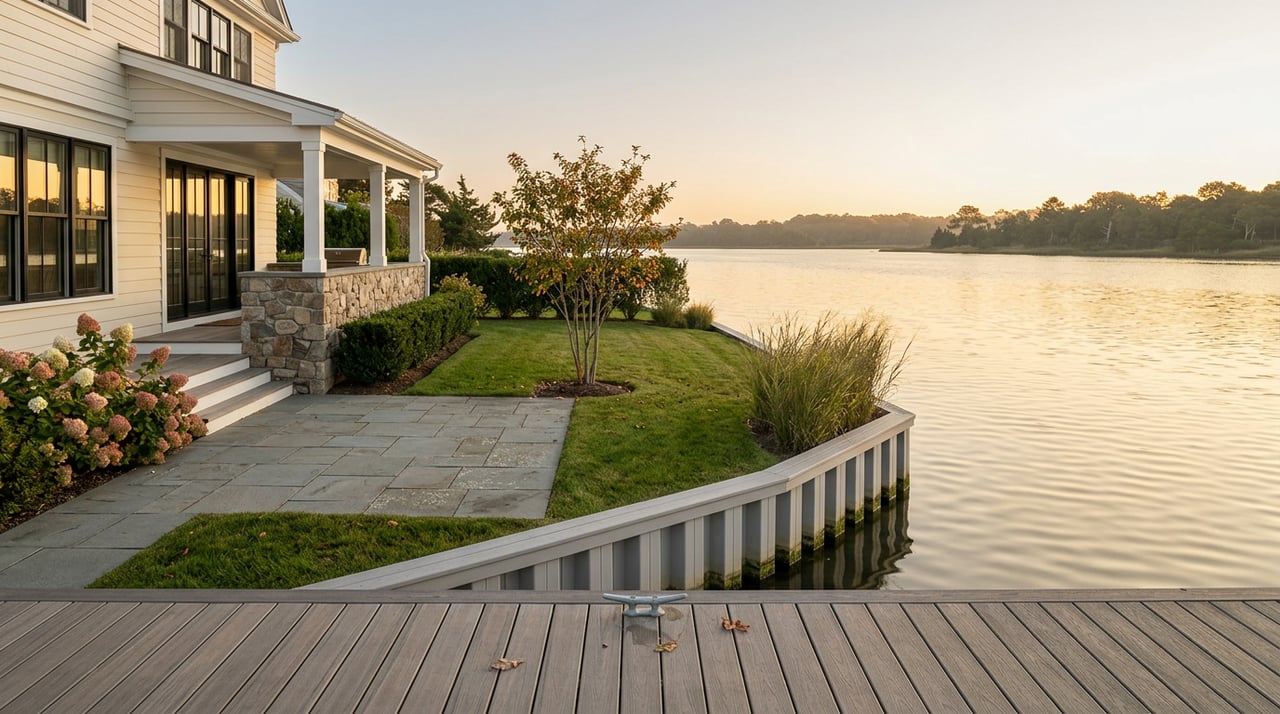
Much of Brick's waterfront inventory, in sections like Shore Acres, Sandy Pointe, Baywood, Seawood Harbour, and Bay Head Shores, sits on land that was carved out of tidal marsh decades ago. Developers dredged channels, filled the excavated soil back onto the building lots, and built the lagoon communities that now define Brick's waterfront identity.
Under New Jersey law, any land that was ever flowed by the mean high tide of a natural waterway is still legally owned by the state, even after it's been filled in and built over. This applies whether the tidal flow stopped a century ago or last year. The legal term is a tidelands or riparian claim, and it functions as a cloud on the property's title regardless of whether the current owner has ever heard of it.
That last part matters. A homeowner can live on a lagoon lot for thirty years, pay taxes on the full parcel, mow the lawn down to the bulkhead, and still not own that strip of land in the eyes of the state. The claim doesn't disappear with time or ignorance. It surfaces the moment someone runs a proper title or tidelands search, which is usually the moment a sale is already underway.
Clearing it requires either a tidelands license, which is a short-term rental arrangement with the state, or a riparian grant, which is an outright purchase of the claimed land from New Jersey. The cost of a grant is not fixed. It scales with the square footage of the claim relative to the appraised value of the land, and it can range from a $1,000 minimum on a small claim to hundreds of thousands of dollars on a larger one. There is no way to know which end of that range your property falls on until a survey and title search are actually run.
What This Looks Like Mid-Contract
Here's where the friction becomes real for a seller who didn't plan ahead. A buyer's attorney or title company runs a tidelands search as a routine part of due diligence on any waterfront lot. If a claim turns up and hasn't already been cleared by a prior grant, the transaction doesn't automatically fall apart, but it does stall while someone figures out how to resolve it. In practice that often means the seller's proceeds get held in escrow at closing until the grant is finalized, because the buyer's attorney won't let a cloud on title pass through the deed.
The timeline compounds the problem. NJDEP's own instructions for riparian grant applications describe roughly a one-year processing window because of the complexity of the review and the number of state approvals required. Other legal guidance on the process puts it closer to two to three years, especially when the claim requires a full riparian survey before the application can even be filed. Either estimate is longer than most people expect to wait for a check.
| Step | Typical Timeline | Who Handles It |
|---|---|---|
| Tidelands claim search | Days to a few weeks | Title company or licensed searcher |
| Riparian survey, if claim confirmed | Weeks | Licensed surveyor |
| Riparian grant application review | About 1 year per NJDEP, up to 2 to 3 years per legal counsel | NJDEP Bureau of Tidelands Management |
| Escrow holdback at closing | Duration of the above | Buyer's title company |
None of this is unique to distressed or unusual properties. It's baked into the legal history of how Brick's lagoon neighborhoods were built.
The Bulkhead Question Hiding Inside the Land Question
Bulkhead permitting adds a second layer, and it's tangled up with the same title issue. Before a riparian grant can be finalized on a lagoon lot, the state's Bureau of Tidelands Management typically wants proof that any existing bulkhead was properly permitted in the first place. Attorneys who handle this work regularly describe the permit search as more time-consuming than the grant application itself.
The dividing line is September 26, 1980. Bulkheads installed before that date can often qualify for a regulatory exemption from the current permit requirement. Bulkheads installed after it generally need a documented Waterfront Development Permit, and if one was never obtained, the current owner may need to apply for an after-the-fact permit before the sale can close cleanly. Confirming which category a bulkhead falls into means pulling a present-day survey and comparing it against the original permit map to see whether the wall has ever been moved outward into the water. If it has, that's a separate problem to resolve before the grant can proceed.
This is exactly the kind of paperwork that sits untouched in a filing cabinet for decades until a sale forces someone to go looking for it.
What to Check Before You List, Not After You're Under Contract
If you own waterfront property in one of Brick's lagoon sections and a sale is somewhere on your horizon, the smartest move is to get ahead of these two checks months before a buyer's attorney does it for you.
- Order a tidelands claim search through a title company that regularly works Ocean County shore closings, and ask specifically whether any portion of your lot has ever been flowed by mean high tide according to the state's maps.
- If a claim exists, find out whether a prior owner already obtained a riparian grant. Many long-held Brick properties have one buried in old closing documents that nobody thought to mention at resale.
- Locate any bulkhead permit paperwork, or a construction permit from the township that at least documents when the wall went in, since that date matters for which regulatory path applies.
- If no permit exists and the bulkhead was installed after 1980, start the after-the-fact permit conversation with a New Jersey environmental attorney before you have a signed contract with a closing date attached to it.
- Budget the possibility of a riparian grant fee separately from any bulkhead repair costs. They are two different lines of spending, and only one of them is optional depending on your lot's history.
None of this replaces a normal pre-listing inspection. It sits alongside it, addressing a category of risk that a home inspector isn't licensed to look for and a bulkhead contractor has no reason to mention.
The Lesson From the Council Meeting
What made December's meeting notable wasn't really the dollar figures, though the gap between $646 and $1,171 a linear foot is real and worth remembering if you're budgeting your own repair. What it demonstrated is that even a township with its own engineers, its own contractors, and its own budget process can be caught off guard by what waterfront infrastructure actually costs once the bids come in. A private seller, working without that institutional backstop, has even less room to be surprised mid-transaction by a title issue that predates their ownership entirely.
If you own a lagoon-front or bayfront home in Brick Township and you're weighing a sale, the conversation worth having isn't only about paint colors and staging. It's about pulling the tidelands search now, while you still have months to resolve what it finds instead of days.
Camille Simms works Brick Township's waterfront communities specifically, from the Metedeconk River lagoons to the Barnegat Bay bulkheads, and can walk you through what a title and tidelands review is likely to surface on your property before a buyer's attorney does it for you. Request Your Free Home Estimate & Marketing Plan to start that conversation before you list.